
How to Stay Calm in a Stressful World
Oct 27, 2026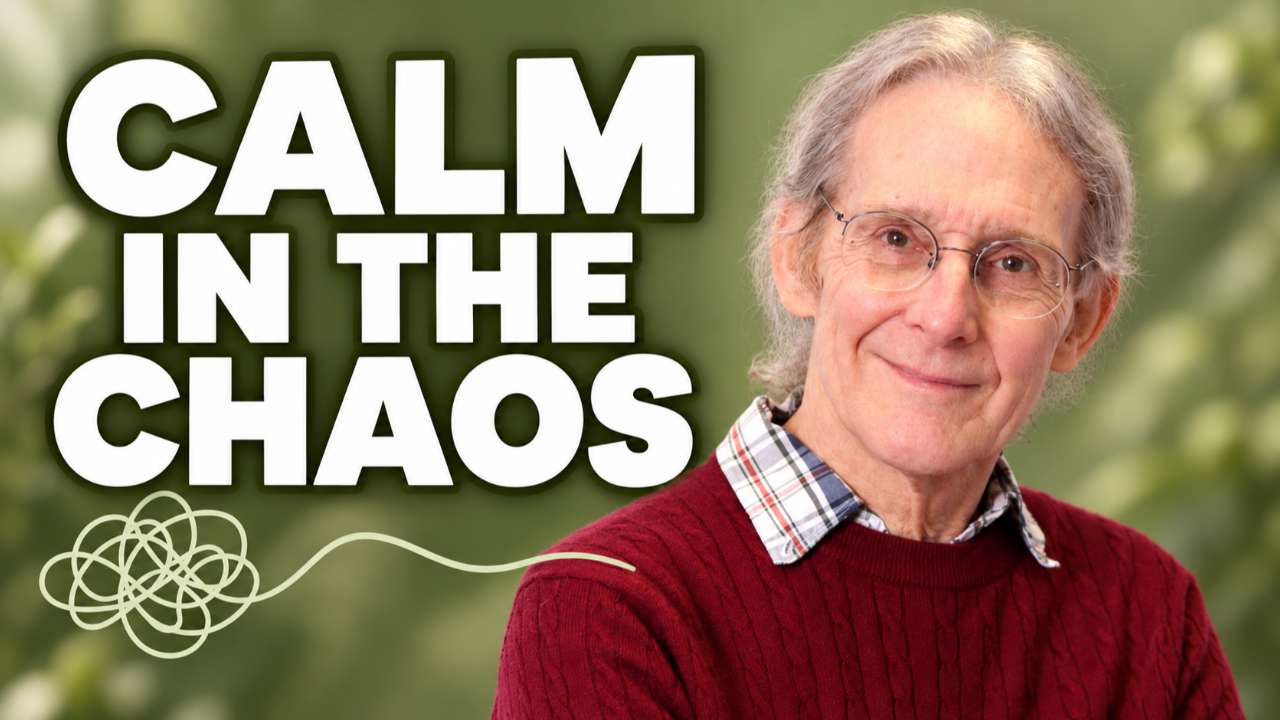
This week, we're going to be talking about approaching life in a calmer fashion. This is a Mind sort of activity, since how we react is really how we decide to react. We've talked about that quite often. And remember, events are received by our senses, but then they're given emotion and meaning by our brain. So we always get to choose how we want to interpret the things that happen around us and to us.
I'm not a calm person by nature. Those of you who know me well know that I prefer to let intense feelings out in the moment, usually verbally. I noticed very often, when I was driving in particular, that I was saying some things and then following that with, "Probably Jesus would have phrased that a little bit differently." So I was getting everything out at once, the verbalization as a kind of stress relief, and then the immediate evaluation and critique. And I thought, well, it's probably really not a great way to do it. I had to admit that pairing an apology with a poor action doesn't really count as an apology anymore. It's kind of justifying it, an excuse.
So I've even mostly stopped random verbal outbursts when driving, which for me is very difficult. The exception is potentially fatal actions, and even then, they're more of a "What were you thinking?" variety instead of just being annoyed about stuff.
So what does all of this have to do with being calm? Well, everything. Driving is one of the more dangerous activities many of us do every day, so our bodies are on high alert. We're looking for pending danger. Plus, that danger often appears without warning, and so our response is guided by our innate habits and automatic survival mechanisms. In other words, it's a pretty good test case for learning to manage your automatic responses to a threat.
And to clarify, by "threat," I mean anything that your brain classifies as a threat. It doesn't have to be someone brandishing a weapon, although that's typically very much a threat. It could be talk of future actions, or louder, aggressive talk. It could be actions which, if they went wrong, could be harmful. Think about electric bicycles on the sidewalk. Think about clouds gathering into thunderheads overhead. It doesn't have to involve a person. Anything your brain considers a threat is a threat to you, and that will elicit a threat response from your brain and your body.
I've always tried to be fairly aware of my surroundings, which is called situational awareness. But even still, things can happen unexpectedly, such as almost walking into a bear in the woods a few days ago. Then there are expected threats, such as opening the newspaper or listening to your preferred media source. You can be pretty sure there will be something in the news that will annoy you. Perhaps a lot.
So if I can rewire my innate response mechanism to be more measured in the case of driving, with its constant unexpected threats, then I should certainly be able to manage my response to anticipated threats, such as annoying news and avoiding bears, which I know live in the woods. Similarly, I also know that talking to people, whether I know them or not, is likely to result in unexpected and perhaps threatening comments related to views, politics, worldviews, et cetera. In all of these cases, I have the ability to anticipate the sort of threat my brain might perceive and control my response to it.
But it goes beyond these immediate threats to other things that my brain may interpret as a threat. Things such as going to a party, or a meeting, or a gathering of any sort. Anything where I'll be exposing myself to something unusual or new. Your brain usually takes that sort of thing as a threat. Even deciding to watch a video from someone I've never watched before. Again, there's an unknown aspect to it, so your brain looks at it as maybe a minor threat, but still a threat.
And this is where the discipline of managing our innate habits and automatic responses really comes into play. Because when you start screaming at a politician on the screen, a few things are happening, and none of them are good. You're confirming to your brain that, indeed, you're under attack from a threat. That has a number of physiological responses to get you all ready for a fight. Except, of course, the fight never comes. So you just have to wait for the adrenaline and all that energy to wear off. But if you pay attention, you'll also notice that your whole body is on high alert. You might be shaking a little bit. Your heart rate is higher. Your breathing will have changed. This all happened because your brain put your body into fight mode, but now you're filled with all these stress hormones and nowhere to use them.
This, as they say, is a bad thing. Constant stress leads to inflammation in your body and your gut, and that, amongst other things, leads to stress on your brain and is a cause of dementia. It also isn't good psychologically. You're training your brain and body that what you see on a screen deserves to be treated as an imminent threat. It's not. It might be annoying as all get out, but it's not an immediate life threat. Finally, when you let yourself get all worked up repeatedly about something that you're not trying to resolve, there's a mismatch between thoughts and actions. That cognitive dissonance is a further cause of stress, leading to inflammation and brain issues.
So what do you do? There are a few steps you can take to change your actions and your response patterns.
The first, of course, is to recognize it. In my case, I made a point of always pairing the reaction with an apology and an affirmation to Jesus that I probably wasn't quite living up to His ideal behavior. You may have other guides. Maybe it's not teaching your grandchildren colorful new words to try out at kindergarten. Whatever works for you, just something that says, "This probably isn't the best way to react to this situation." But whatever your method is, apply it regularly, and then think about it and what led up to it.
Next, look at what is triggering the feeling of threat that you feel compelled to respond to. If it's something on TV or the computer, when you see something that's offensive to you, it can just prompt you to have a quick discussion with yourself about why you strongly disagree with what's being said, instead of reacting strongly to it. I do this often with many comments I hear from experts and politicians when they say things that are just totally false about the war in Ukraine, for example.
And then this next step is very important. Decide. Not reflexively, but deliberately, decide what you will do. You could write to someone, like a newspaper. You could write a blog post. You could call a friend. You could decide to feel sorry for the person saying what you just heard. There are many other options for how you respond. You could also decide to not be actively involved with that discussion. Not because it doesn't matter, but because at this point you're unable, for whatever reason, to act upon it. That doesn't mean that you support it. It doesn't mean that it isn't important to you. It's just acknowledging that you're not infinite and cannot fully change every single thing in the world with which you disagree. That may lead you to a different decision, such as supporting a group in some way who is better able to advocate for the cause that is important to you, but that you can't work on right now. But in every case, it should be a reasoned decision, because then the matter, at that point in time, will be resolved in your head, and it will stop being a source of stress as an unresolved issue.
Finally, think back to the event that caused the stress. Decide if it brings any value into your life. If it was just doom scrolling to pass some time, find some other way to pass some time. If it's a news feed you get, decide if there's enough other useful information to continue getting that news feed. If it's politics related, I would strongly suggest you look at what your party is actually doing for you, and that is for both sides of the aisle. Not what they're saying they will do, not how they're blaming the other team. What have they actually done for you over the past two years? Both parties have had plenty of time to make progress on multiple fronts, and neither one has.
And be involved in finding a solution to the things that you have decided really matter to you. If you think there should be more than two political parties, for example, then work towards that goal. Fun fact: some of the latest polls show that nearly 50 percent of the population disagrees with some or much of what each of the two major parties are doing. That's enough for a whole third party, and that could bring about some change. If you know of a group that supports causes in which you believe, support them in any way you can. If you can't make donations, volunteer. If you can't volunteer, write social media posts talking about how great they are. But support the groups who support your goals.
If you do these things, purposely managing your reactions to threatening situations, and identifying those things that truly matter to you and supporting those, you'll suddenly find that much of the background stress in your life will kind of fade away. And once that unresolved stress is gone, you'll also be less likely to overreact to the other stressors that always show up unexpectedly.
Plus, and this is really a big plus as we age, by removing some of that stress, it will tend to reduce the overall inflammation in your body. That has huge, widely ranging effects in all areas. Not just in your GI tract, which I always think of, since stress knots up my stomach. That's kind of the canary in the coal mine, the leading indicator. But also in your energy levels, the clarity in your mind, how your joints feel. Basically, every aspect of your health will improve when some of the stress goes away.
Stress is a normal part of life, but each stress-causing incident is intended to be resolved. When it's not, it becomes quite toxic. Fun fact: there was a study done. If a rabbit has a near-death experience from a predator, once the predator is gone, the stress goes away. You'd think, "Somebody just tried to eat me!" and it would be scared to go out in the yard again. But it's not, because the stress resolved itself. If the rabbit was in a cage, however, even though the predator is removed, the stress remains, because it now knows it can't get away.
Don't lock the stress up in your head by putting yourself in a cage of thinking nothing can ever be changed and just continuing to subject yourself to more unresolved stress. Be proactive. Decide what you can focus on, in whatever way you can, and learn that you can be calm even in a chaotic world.
That's it for the evening. A quick reminder: we have a short talk and video on the Five Pillars of Life and Aging, where I explain how those five pillars actually affect our lives. The five pillars are our identity, our mind, our body, curiosity, and contribution, and together they form how we view and operate through life. I go through the background on them and how they interact. And it's also a reminder that as we age, some things change, and one of those things may be how we want to balance the impact of those five pillars in our life. So check it out at https://www.7EveryMinute.com/five-pillars-freebie and you might find something fun.
As always, remember that one of the best ways to care for ourselves is to care for others. UKR7.com and WCK.org are two international sites, but local charities and even just a simple smile can change someone's day for the better in ways you can't even imagine.
As always, thank you for stopping by. If you found something interesting or useful, please pass it along. Please subscribe, hit that like button, and have a great week.
Remember to live the life that you dreamed of, because that's the path to true contentment.
Love and encouragement to everyone. See you next week on 7EveryMinute and 7EveryMinute.com.
Stay connected with news and updates!
Join our mailing list to receive the latest news and updates from our team.
Don't worry, your information will not be shared.
We hate SPAM. We will never sell your information, for any reason.
